
Lawrence Projected Versus Actual Release
A projected date is a calculation or eligibility point based on the sentence record as it stands. An actual release date is the day a custodian records that the person left that custody. Ohio makes the distinction especially important because the ODRC field is labeled Expected Release Date/Parole Eligibility Date. The first half can be a projected prison exit. The second half can be only the first point when the Ohio Parole Board may consider release. Neither meaning supports a promise that departure will occur that day.
Pretrial detention works differently. A person awaiting trial does not have a sentence end date. Release may turn on bond, recognizance, dismissal, a court order, or resolution of another hold. Even when a docket shows that bond was set, it does not show that bond was posted or that the jail completed the release. A Lawrence County sentencing entry can establish the legal term, while the jail's register of confinement gives the date of discharge from local custody.
Scheduled versus actual: Use the projected field to plan a follow-up check. Use current status, the discharge record, and the controlling court entry to prove departure.
A transfer is not a community release. If the jail sends a person to an outside-county jail or ODRC, the Lawrence County entry may close while another custodian still holds the person. Current location and transport or destination records resolve that difference.
Find a Lawrence Projected Release Date
Identify the custody system before searching. ODRC is the proper source for a person committed to an Ohio prison or shown in state supervision data. The Lawrence County jail and the sentencing court are the proper sources for a local jail term. Federal dates belong to the Bureau of Prisons, not the Ohio field. Exact identifiers matter because two people can share a name.
- Find the court and case number. Use Lawrence County Common Pleas eServices for a felony case, then read the signed judgment for the term, jail-time credit, and whether terms run together or one after another.
- For state prison, open the ODRC Offender Search. Search by name or ODRC number and compare age, offense, admission data, and Lawrence County of commitment.
- Read Status, current location, sentence rows, jail-time credit, and Expected Release Date/Parole Eligibility Date together. Do not isolate the date field.
- For a Lawrence County jail term, use the official sheriff jail page and the correct court to ask about the current calculation in existing records. No local public date calculator was found.
- Recheck the custodian and court near the planned date. A later order, hold, credit decision, or Board action may change the result.
A county jail stay that never became an ODRC commitment will normally not appear in the state offender search. In the opposite direction, a person missing from Lawrence County after a felony sentence may be active at an ODRC institution. That result proves continued state custody, not release. The broader search path and local confinement-record request are described on the Lawrence County released-inmate page.
Note: A name-only result is not enough; match the ODRC number, case, offense, county, and admission facts before using a release date.
Lawrence ODRC Release Date Fields
The state detail record contains several milestones. Admission Date is the date ODRC originally received the person. Jail Time Credit is confinement that counts against the applicable term. Expiration of Supervision Term concerns the maximum APA control period and is not a prison release date. Earliest Possible Transfer Date concerns potential transitional control, which is a possible move rather than guaranteed discharge. Expired Stated Term concerns sentence expiration after jail-time credit under the state's definition.
| ODRC field | What it can establish | What it cannot establish alone |
|---|---|---|
| Status or current location | Whether ODRC reports an institution, APA placement, or release-related status | The full legal reason for a past Lawrence County departure |
| Expected Release Date/Parole Eligibility Date | A projection or first parole-consideration point under the sentence | A guaranteed actual release day |
| Jail Time Credit | Credited confinement shown in the state calculation | Earned program credit or every later adjustment |
| Expiration of Supervision Term | The maximum displayed period under APA control | The date the person left the prison building |
| Board result and POA/PRD | Parole consideration or an approved projected action as displayed | Proof that the planned release happened |
The official ODRC definitions explain the combined release-date label and related fields. The captured definitions screen below preserves the agency's wording and context.
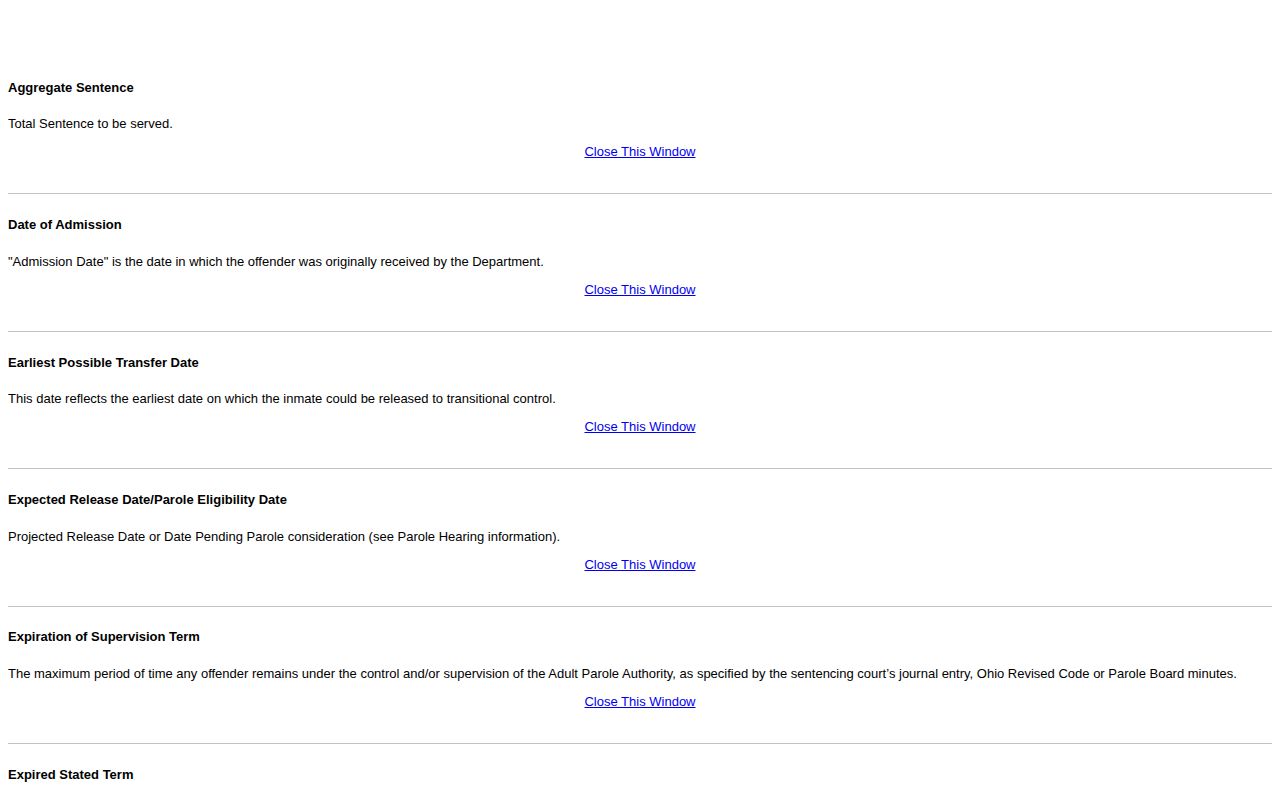
Those definitions show why a displayed date must stay tied to its original label. Rewording parole eligibility as a sure exit would change the record's meaning.
Lawrence Release Date Sentence Credit
Ohio sentence calculations can include jail-time credit and earned credit, but they are not the same. Under ORC 2967.191, qualifying confinement arising from the offense can reduce an applicable term or parole-eligibility date. Examples in the law include time held in lieu of bail and time awaiting transport. That credit accounts for confinement already served before or around prison admission.
Current earned credit is governed by ORC 2967.194. Eligible people may provisionally earn one or five days per completed month for productive participation in qualifying programs. A second qualifying activity can add credit within the statute. Certain completion credits may be 90 days or ten percent of the stated term, whichever is less. Ordinary aggregate credit under the relevant provision generally cannot exceed 15 percent of the total stated prison term.
That limit produces the common “85 percent” shorthand, but Ohio does not impose a universal rule that every person serves exactly that share. Major exclusions and distinct rules apply to murder, aggravated murder, life without parole, non-reducible mandatory terms, specified sexual sentences, and other categories. Sentence generation also matters. ODRC may deny or withdraw provisional credit after rule violations.
Ohio Administrative Code 5120-2-06 implements productive-program credit. Rule 5120-2-03.2 separates calculation rules for several sentencing eras. Historical good time cannot be copied onto a current sentence. No published Lawrence County jail good-time rule or weekend-release policy was located, so a local jail date must come from the court and jail rather than a guessed formula.
Why Lawrence Release Dates Change
A projected release date can move because the inputs or governing legal action change. Some changes reduce time. Others extend custody or replace the expected path with a hearing. A clean comparison must distinguish a new calculation from a new custodian. For example, a detainer can cause a direct handoff even if the original term ends as planned.
| Factor | Possible effect | Record to check |
|---|---|---|
| Jail-time credit correction | Moves the computed sentence point when credited confinement changes | Signed court entry and ODRC sentence row |
| Earned credit or credit loss | Can shorten an eligible term or remove provisional credit | ODRC calculation and applicable statute or rule |
| Judicial release | Can produce an actual exit before the earlier projection | Common Pleas journal and current ODRC status |
| Parole decision | May approve, continue, or deny a discretionary release path | Board result, minutes, and current detail record |
| Detainer or other hold | May cause continued custody or a handoff to another agency | Jail or ODRC destination record and issuing case |
| SB 201 hearing | May continue confinement beyond a presumed minimum, but not beyond the maximum | ODRC action and ORC 2967.271 record |
For Reagan Tokes or SB 201 non-life indefinite sentences, ORC 2967.271 presumes release at the minimum or a qualifying presumptive earned-early-release date. ODRC may rebut that presumption after a hearing based on listed conduct, safety, restrictive-placement, or classification grounds. Confinement cannot continue past the maximum term.
Note: A transfer date, parole-eligibility date, and supervision-expiration date mark different events and should never be merged into one Lawrence County release date.
Lawrence Judicial Release Date Conflicts
Some Lawrence County ODRC records reveal a subtle conflict. The current status can read “Released - Judicial Release” while the detail still shows an older Expected Release Date/Parole Eligibility Date from the original sentence calculation. In that situation, the current release status and release type outrank the stale projection when the question is whether departure already occurred. The signed Common Pleas journal entry supplies the legal basis under Ohio's judicial-release process.
The public ODRC judicial-release example assigned in the Lawrence research displays that combination. The image below captures the status and the expected-release field in one official record.
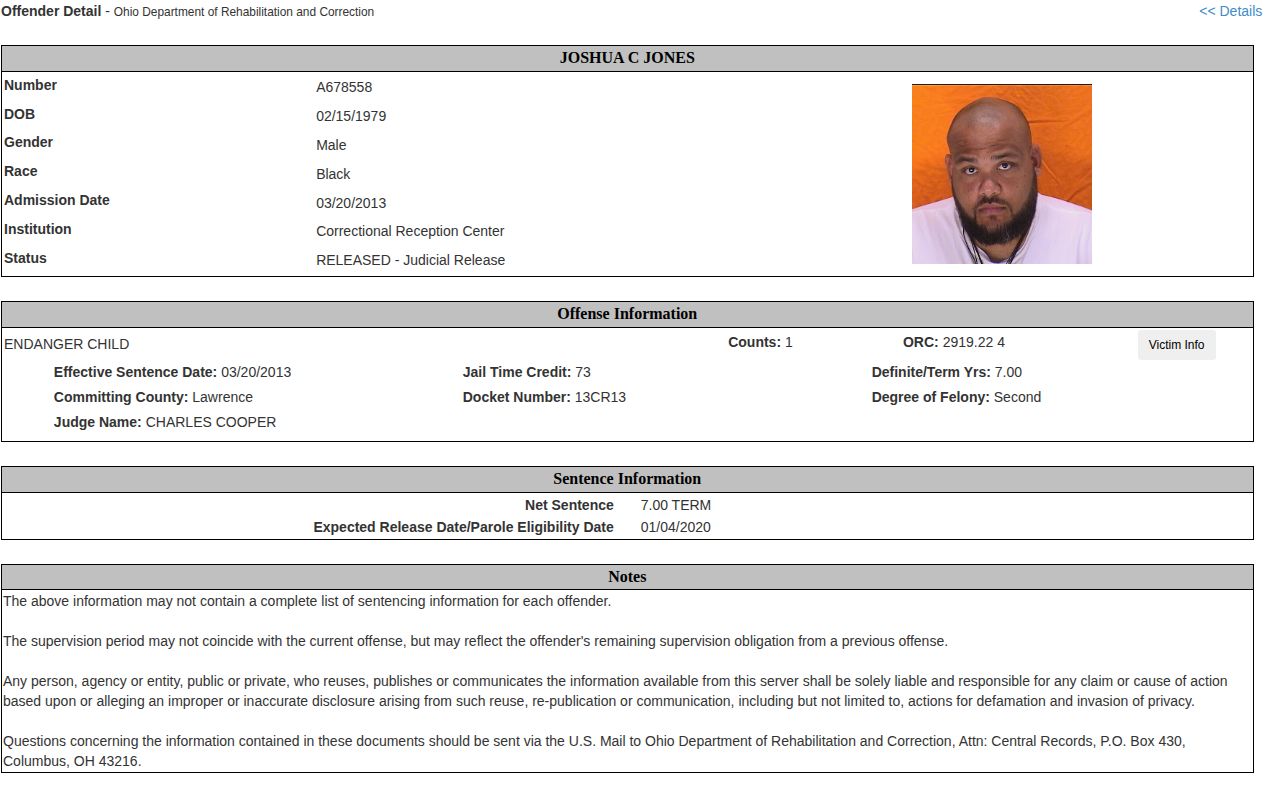
This result shows why a search should begin with current status and then interpret the date. The expected field remains sentence context, not proof that the person stayed confined until that earlier projection.
A docket label by itself is also incomplete. Retrieve the signed journal entry, match the case to the ODRC number, and confirm that no new institution or supervision placement changes the present answer.
Confirm a Lawrence County Release
Near the projected date, check the same custodian that holds the person. For ODRC, read the current offender status, institution or APA placement, and any release-related entry. For a Lawrence County jail term, contact the jail at 740-532-5819 and compare the register of confinement with the court docket. The Lawrence County Municipal CaseLook is one local path, while felony matters belong in Common Pleas. Ask whether the event was release to the community, outside-county transfer, ODRC transport, or another agency hold.
Ohio VINE can add a custody-change alert. County sources can report general release, transfer, escape, or death, while ODRC provides a wider set of prison and parole events. A transfer alert is not a community exit. Registration and source limits are explained on the Lawrence County VINELink Check. Save the alert, then verify its reason and destination with the supplying agency.
For a past local term, request the register-of-confinement entry, which Lawrence County's retention schedule says includes the date of discharge and is kept for 125 years. For a state-prison term, the current ODRC status plus the court record gives a better answer than the projected field alone. The final test is simple: a future estimate helps plan, but an official status and discharge record prove what happened.